
Verstappen wins Singapore Grand Prix, Hadjar earns point after pit-lane start as teams assess race-day strategies
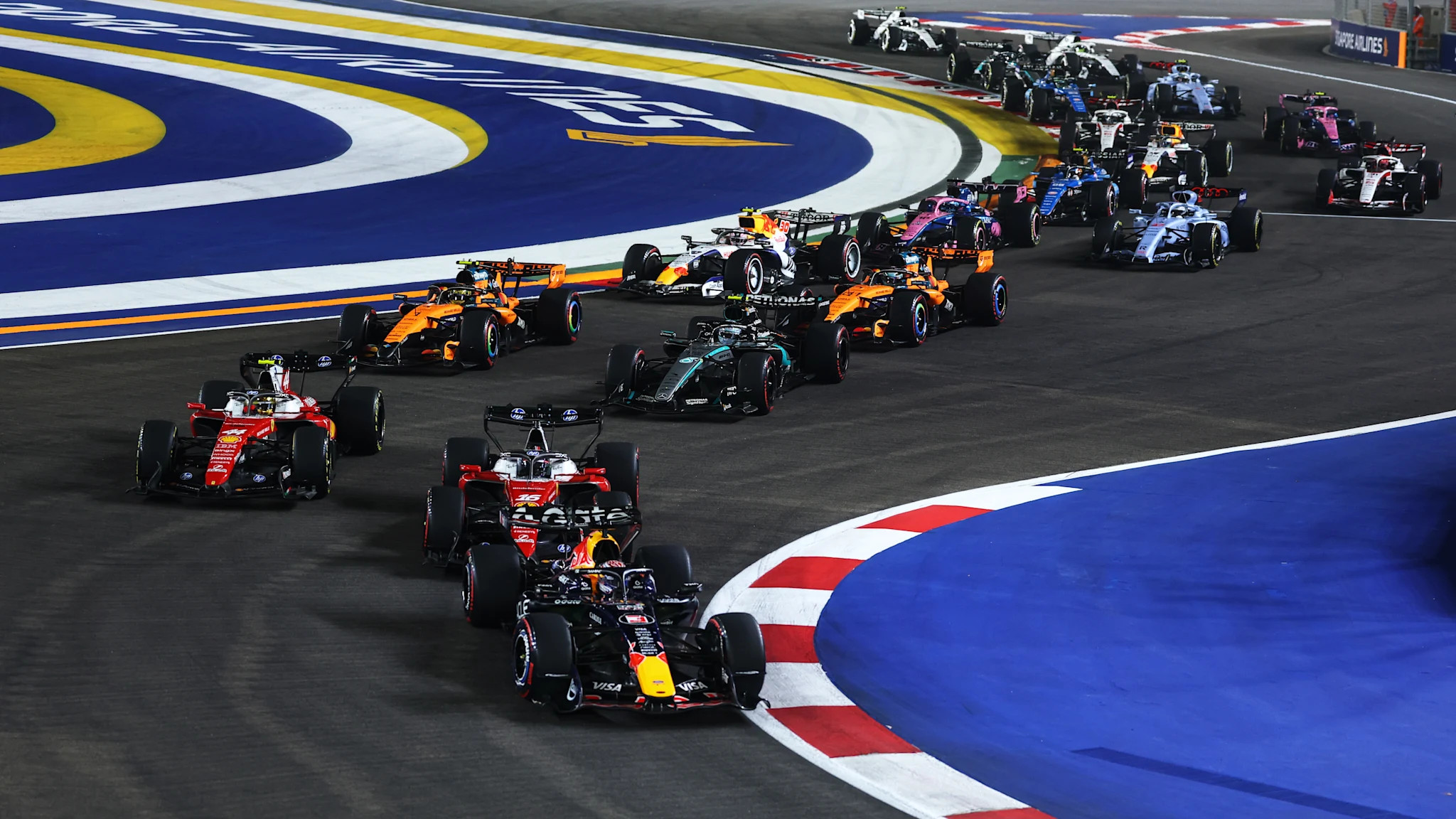 Image accompanying the official F1 announcement.
Max Verstappen capped another dominant Formula 1 weekend in Singapore by winning the Grand Prix after already taking Sprint victory. Speaking after the race, Verstappen said the car “was working well all weekend” and that once he was in clean air he could “get into a rhythm,” even though he had to manage race issues including “the radio not working.” Red Bull’s team principal Laurent Mekies praised Verstappen for extracting “the maximum” from the package, highlighting a result that featured Pole and wins in both the Sprint and the Grand Prix. Mekies also framed the start as a key factor, noting the race was “never straightforward” and that retaining the lead depended on a critical opening phase that the team and Verstappen managed successfully.
Mekies said the team came into the weekend with a broad competitive outlook but still expected challenge at a demanding circuit. He described Singapore as a place where small errors can be decisive, and said the team’s garage crew responded effectively “session after session” after the challenges thrown up during the race and throughout the weekend. He added that Verstappen’s victory was also meaningful for the team given it was the first time Max had added Singapore to his list of wins, while also stressing that even with two poles and two wins there were “still areas we want to improve” going into the remaining races.
For Isack Hadjar, the weekend included a complication before the Grand Prix even began. Under Parc fermé conditions, Hadjar changed his set-up and also took on more power unit components, forcing him into a pit lane start. Despite beginning from behind, Hadjar fought back through the field and, according to his account, capitalised on cleaner running and tyre differences—saying the Soft tyre made progress possible once he got into clean air. He later passed Pierre Gasly late to secure “the final point on offer,” finishing 10th. Hadjar credited the garage for the effort required to convert a difficult track position into points, and said the result confirmed the team had pace heading to Austin.
Charles Leclerc finished second, with Mekies and Leclerc both attributing the outcome to strategic and tyre timing during key race interruptions. Leclerc said Red Bull and Verstappen were “very strong all weekend” and that while he pushed he was not quite able to catch him. He also pointed to “the right calls today, with a different strategy.” The race narrative provided from team comments made clear that Leclerc was close at the start before settling into a chase, then gained an advantage through a series of pit stops and a late Virtual Safety Car period—one that allowed Leclerc to pass Lewis Hamilton after Hamilton stayed out, which Hamilton later said was his own decision.
Lewis Hamilton ended sixth, and he said the result was “on me,” describing a difficult afternoon where his planned tyre strategy did not play out as expected. Hamilton explained he started on a new Medium tyre to “go long and try to make a one-stop work,” but said the Medium “didn’t perform as well as the soft.” He said his second stint pace returned, yet he could not progress under race conditions, and his night was further complicated when the team called him in under VSC but he missed the pit entry. Hamilton later chose to remain out to hold track position, but he said tyre degradation in the closing laps forced him to lose three places and finish P6.
Mercedes assessed the Grand Prix in terms of both strategic planning and the limited information available about tyre behaviour. Toto Wolff said the race was shaped by the need for overtakes, given that Mercedes cars started from P4 and P19 due to penalties. He noted that decisions were made with limited tyre knowledge and that the Soft “turned out to be stronger than expected compared to the Medium,” which influenced how the teams kept options open. Wolff also said VSC timing left Hamilton disadvantaged when he missed the pit entry, while Kimi Antonelli was able to take the final podium spot through on-track passes and tyre performance. Antonelli’s team-mate, George Russell, finished ninth after his charge stalled behind Nico Hülkenberg; Russell described the Virtual Safety Car stopping as he entered the pit lane as an example of how “luck sums up my season unfortunately.”
Kimi Antonelli’s podium finish stood out among the race-day reflections, with Mercedes crediting a combined approach of strategy and tyre management. Antonelli said overtaking would be difficult and that the team tried “some things a little bit differently” on strategy, using the expectation that the Soft would be better. He described capitalising on battles between Norris and Hamilton and then passing both and taking P3. Antonelli also pointed to progress from Mercedes’ update package, calling the weekend an “experiment” that offered a useful direction for future upgrades, and said confidence can carry into Austin.
McLaren’s race outcome was split between a strong recovery for Lando Norris and an interrupted evening for Oscar Piastri. Norris finished fourth and said it was “the best we could achieve,” describing a hot, demanding race where every corner was “a fight.” He acknowledged the gap in outright pace compared with Red Bull and the performance of competitors such as Mercedes and Ferrari, and said strategy “couldn’t create more today.” For Piastri, the team comments described an unscheduled second pit trip caused by a slow puncture after a long first stint, leaving Norris to fight for the podium while Piastri recovered to fifth. Norris said after passing Hamilton he had P4 secured, while Piastri later chased down the Ferrari and passed on the final lap to secure P5.
All the post-race comments pointed towards Austin as the next major benchmark, with several teams framing Singapore as a test of tyre behaviour, strategy flexibility and upgrade direction. Verstappen looked ahead to a circuit he called “very different” and “very bumpy,” while Mekies suggested Red Bull would aim to carry momentum. Mercedes leaders similarly stressed that the data gathered from the weekend’s update evaluation would shape preparation for Austin, with Wolff and engineering staff describing a clearer understanding of what each specification can deliver once it is working in the right window.
In Singapore, the Grand Prix results confirmed a clear hierarchy in race execution: Red Bull converted early control into victory and Sprint momentum, Mercedes delivered a podium through Antonelli’s charge, and McLaren’s clean management off the line preserved top-five points despite puncture disruption. With Austin next on the schedule, teams will be assessing whether tyre trends and strategic patterns seen in Singapore can be repeated—or exploited differently—on a track described by multiple comments as offering very different demands.
Reporting source: F1 official update