
Toto Wolff explains why Mercedes’ late push collapsed in Las Vegas
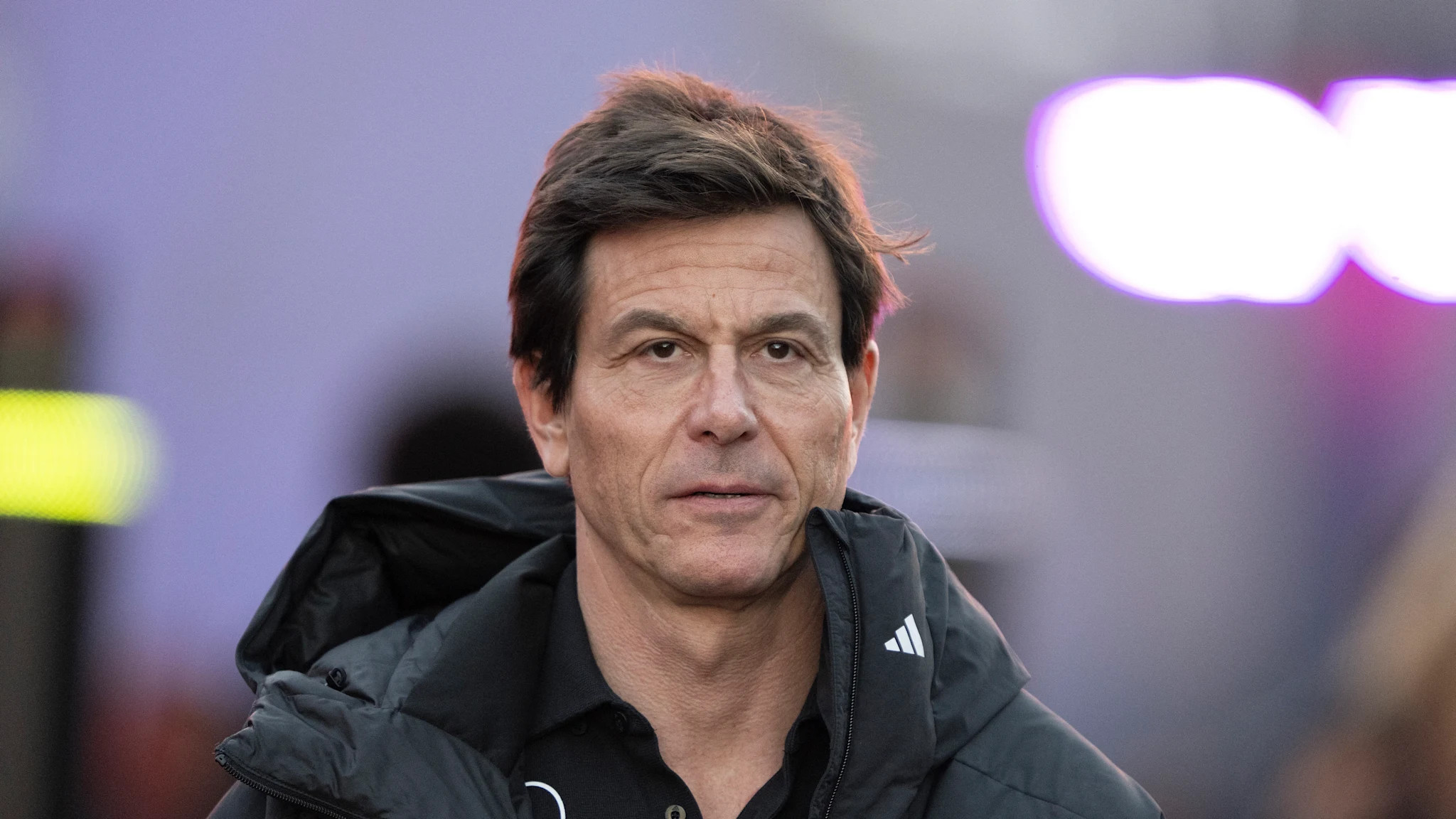 Image accompanying the official F1 announcement.
George Russell and Kimi Antonelli were both positioned to contend for victory in the Las Vegas Grand Prix, with Wolff later describing a late-race swing that turned a potential Mercedes double podium into a difficult finish. In the final laps, Wolff said Russell’s attempt to make ground on the “dirty part of the track” ended with a braking mistake, while Antonelli’s energy deployment did not survive the closing sequence that Mercedes believed would be decisive.
Wolff said that with three laps remaining, Russell locked up and slid into the barrier. He characterized it as an error of judgment: “I think from George’s side he made an ambitious move there on the dirty part of the track, and obviously he missed the braking and hit the wall, so it was an error of judgment.” Wolff’s explanation linked the incident to a challenging surface condition rather than a mechanical problem, and he noted the result in the classification context provided by the report: Verstappen was the winner, the “new World Champion” finished fourth, and Russell ultimately had to settle for ninth after reversing out of the barrier.
For Antonelli, Wolff described a separate failure mode tied to the race’s energy rules. He said the plan had been an “epic last lap” in terms of energy deployment, but that Antonelli lifted on the back straight instead of passing Verstappen, which then triggered a full battery depletion: “I think everything was set for an epic last lap in terms of energy deployment, and then unfortunately on the back straight, rather than passing Max, he lifted, and that caused the battery to be totally depleted. He had no energy left.” Wolff added that the consequence was immediate: Antonelli was passed after effectively having no remaining battery power.
In Wolff’s account, Antonelli’s lifts-and-reapplication sequence left him with nothing to use when others came through. Wolff said, “Why we got passed is because he literally had no battery. He wanted to stay behind Max, so he lifts, he reapplies, and the battery is empty.” He extended the explanation by pointing to the ripple effect across the field: he said other cars—specifically referencing Alpine driver Pierre Gasly—were able to overtake “left, right, and centre,” describing the situation as complex and one in which the energy state can quickly determine the outcome.
Wolff also addressed a specific tactical belief about the final segment. He said Mercedes still believed it had a “last weapon” available for the last 400 metres over the left kink, implying Antonelli could have overcome Verstappen if that final energy opportunity had been preserved: “We had a last weapon up our sleeve for the final 400 metres over the left kink. I think he would have just saved it over the line to win the race—but obviously we lost that opportunity.” The team’s overall narrative therefore rests on two near-misses: a missed braking window for Russell and an energy depletion chain for Antonelli.
Despite the disappointment, Wolff said he credited Verstappen for getting the result. He called Verstappen a “deserving winner,” adding that the Red Bull driver “made no mistakes” and had “a response” throughout the race under pressure. Wolff also said he enjoyed the spectacle and the close, rules-driven nature of the event, describing the Las Vegas race as especially entertaining because energy management, slipstreams and overtaking opportunities created uncertainty about positions until the end.
Wolff’s assessment, as relayed, placed the emphasis on how quickly the outcome can flip within seconds in a modern energy-controlled format. He said instant feedback from friends watching and “our sponsors” was that the race was “awesome,” and he argued that Las Vegas suited that kind of high-intensity racing atmosphere, likening it to a blend of different American motorsport styles before concluding that the decisive factor was who managed the energy levels best.
Reporting source: F1 official update