
Kimi Antonelli sets multiple F1 records on the way to his first World Championship
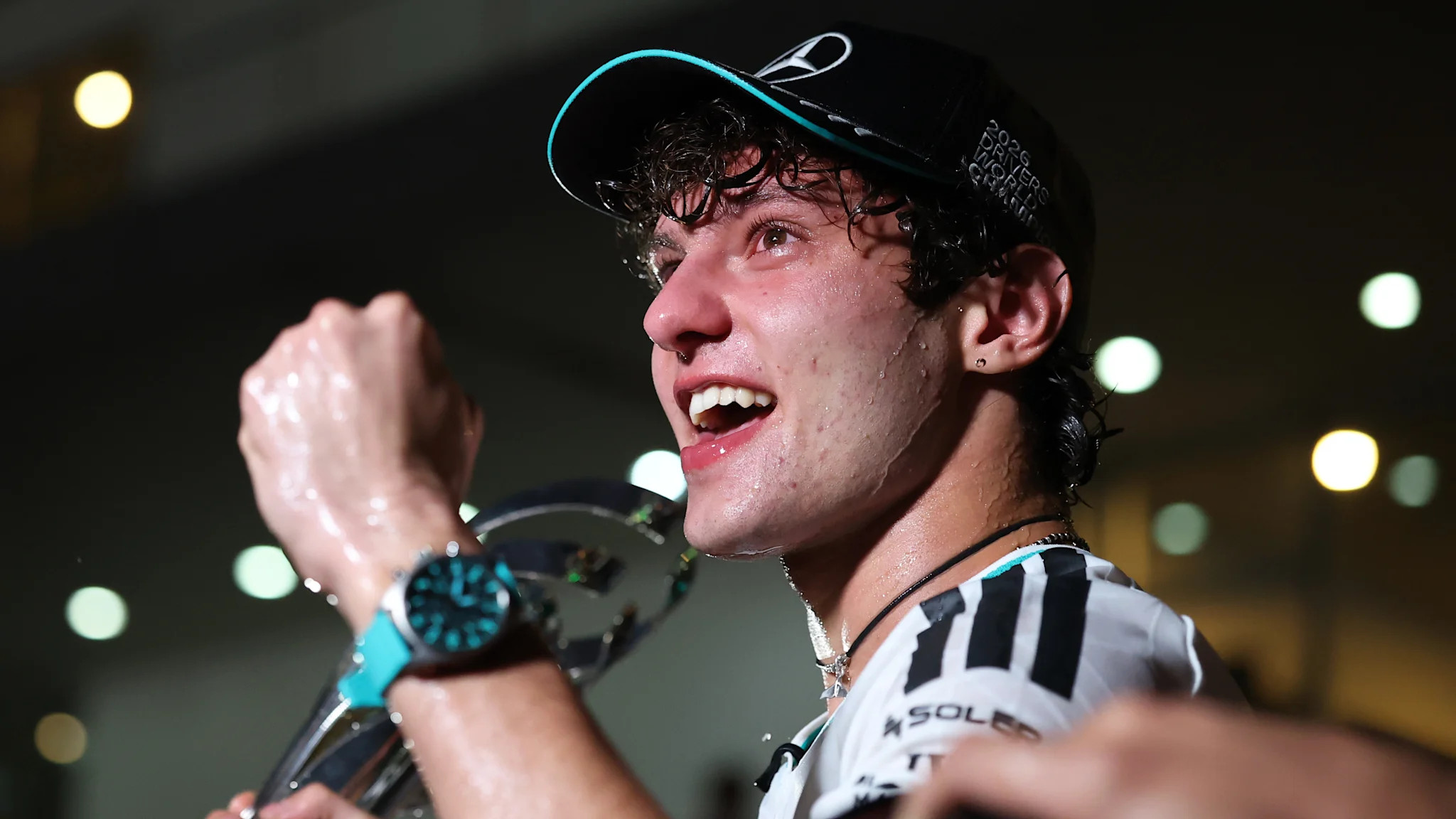 Image accompanying the official F1 announcement.
Kimi Antonelli’s 2026 campaign has been marked by repeated record-breaking performances en route to his first Formula 1 World Championship. According to F1.com’s historical summary, the Mercedes driver clinched the title in only his sophomore season and did so as the sport’s youngest-ever World Champion at 19 years, six months and 18 days old.
The records began early. Two rounds into the championship at the Chinese Grand Prix, Antonelli secured pole position for the first time at a Grand Prix. The site reports that this made him F1’s youngest-ever polesitter at 19 years, six months and 18 days, beating Sebastian Vettel’s prior record—set when Vettel took his debut pole position at the 2008 Italian Grand Prix at the age of 21.
In Shanghai on Sunday, Antonelli converted that pole into his debut win, F1.com says, becoming the youngest driver in history to win from pole. The record for youngest-ever race winner remains with Max Verstappen, who first won at 18, but Antonelli’s achievement still underscored how quickly he translated qualifying success into race results.
The next landmark came at the Japanese Grand Prix. F1.com reports that Antonelli won there to claim his second victory of the campaign and, in doing so, climbed to the top of the drivers’ standings. The site also credits him with breaking another age-related record: becoming the youngest-ever leader of the World Championship at 19 years, seven months and four days, ahead of the previous benchmark established by Lewis Hamilton, who headed the table at 22 in 2007.
F1.com says Antonelli then extended a streak of converting pole to victory, following his Chinese and Japanese wins with another strong result at Round 4 in Miami. The publication attributes his run to an additional season-defining record: Antonelli became the only driver in history to win from their first three pole positions.
As the season progressed, F1.com reports Antonelli amassed five consecutive victories across the opening stages, then added two more back-to-back wins after his Miami success. The sequence set up a particularly historic moment at Monaco, where the site highlights his composure through Monte Carlo’s tight streets as he won to make him F1’s youngest-ever winner of the Monaco Grand Prix.
Monaco also delivered a Grand Slam, a rare feat in which a driver starts from pole, sets the fastest lap, leads the race from start to finish and wins the race in the same weekend. F1.com says Antonelli joined the small list of 29 drivers overall to have achieved a Grand Slam, becoming the youngest driver ever to earn the accolade.
The Italian Grand Prix then added another layer to Antonelli’s record run. F1.com says his victory at Monza was his seventh win of the season and included a “home race” milestone: he became the first Italian to win at his home Grand Prix since Ludovico Scarfiotti in 1966. The publication frames the moment as a culmination of Italy’s long wait—highlighting that Antonelli’s title ended a 73-year gap since the country’s previous World Champion.
F1.com also places Antonelli’s championship win in broader historical context. The site notes that he is only the third Italian to take the crown, joining Giuseppe “Nino” Farina (the inaugural champion in 1950) and Alberto Ascari (back-to-back titles in 1952 and 1953).
Finally, F1.com emphasizes how Antonelli’s age differentiates him from recent champions. The publication recalls that Vettel previously held the youngest World Champion mark at 23 years, four months and 11 days when he clinched in 2010. It adds that the past five seasons had featured World Champions born in the 1990s, including Max Verstappen (first from the 1990s to win in 2021) and Lando Norris; Antonelli, by contrast, is the maiden title-winner born during the 2000s (2006), the same year Fernando Alonso took the crown for a second time.
(Research note: The provided source is a records recap from F1.com. It includes age-based and historical claims but does not provide the underlying race-by-race statistical tables or official session results for each referenced Grand Prix. Additional primary documents (FIA timing sheets, official F1 results, or FIA championship tables) would be needed to independently verify every specific age calculation and record description.)
Reporting source: F1 official update