
Mercedes to run two different aero configurations in Singapore for Antonelli and Russell
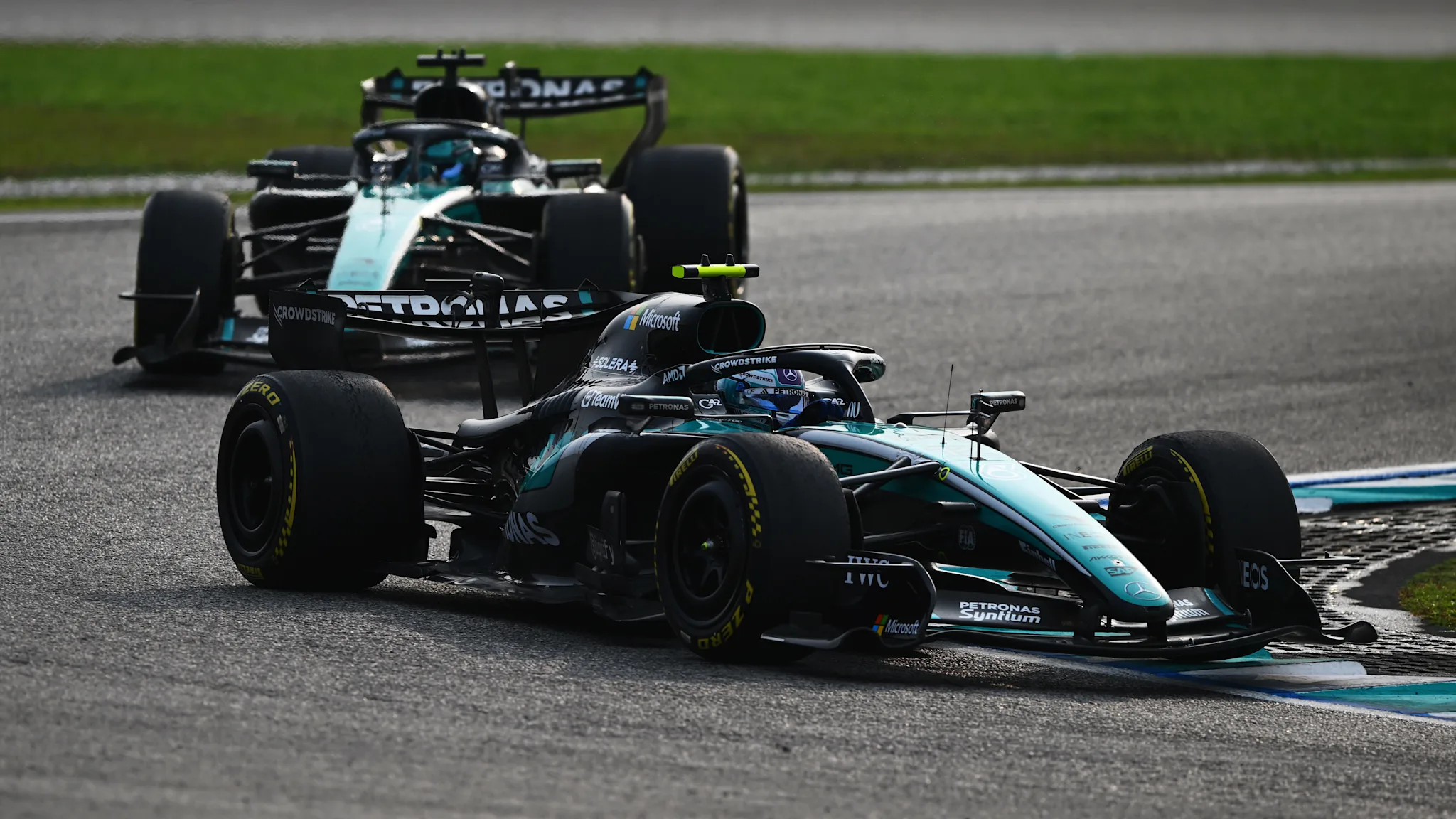 Image accompanying the official F1 announcement.
Mercedes will take an unusual approach for the Singapore Grand Prix, running two different aerodynamic configurations on its two W17s over a hectic Sprint weekend. The team has committed to splitting its car specification between drivers across all three days, aiming to produce a direct back-to-back comparison in a race environment that is expected to be more representative than the previous round.
Kimi Antonelli will keep the updates that were introduced in Malaysia and used last weekend, including an additional new front wing for Singapore that “completes the update package.” Mercedes’ rationale, according to the statements in the team’s media activities, is that the performance outcome from the Sepang upgrades was considered inconclusive rather than clearly positive or negative, even though the weekend contained strong individual results.
George Russell, by contrast, will revert to the previous aero version for Singapore after the team judged that the upgrade results had not delivered the lap-time gains it had hoped for. Russell has said he raised the idea of using Singapore as a back-to-back test earlier, but that his late retirement in the preceding period triggered a power unit grid penalty for the Singapore weekend—removing uncertainty and making the decision “a total no-brainer.”
Russell pointed to the variability in recent results to support the view that the Malaysia outcome may not be a true indicator of the package’s ceiling. He noted that a car matching the one used in Baku was also used in Budapest and Zandvoort, with pole achieved by eight-tenths in Baku and the team described as being four-tenths off the pace in Budapest. He argued that even with rivals running the same baseline conditions, deltas of around one second across similar performance expectations show how drastically conditions can skew the signal, leading Mercedes to conclude the Malaysia effect was specific to that weekend.
Russell also linked the decision to the competitive context around Red Bull and the gap and pace relationships with McLaren and Ferrari, while stressing the opportunity the grid penalty created to roll back and evaluate. “It’s the car that I won in Baku with – so let’s see,” he said, framing the return to the older configuration as both a test and an attempt to regain a known performance baseline on a track he expects to suit it.
Antonelli said he was not deciding between packages himself, explaining that it was the team’s call to revert Russell. He argued that Sepang may have been an outlier, citing the track surface and heat, including periods of 60-plus degree track temperatures and difficulty in low-speed corners. For Singapore, Antonelli expects cooler conditions, a better state of the tarmac, and a track profile that should make the test more meaningful because it includes “a lot of low-speed.”
Antonelli said he welcomed the chance to understand the new parts rather than “write it off so early,” noting that the team has invested heavily in the upgrade and that the older package is already well understood in setup terms. With two distinct aero packages on the same weekend, he said Mercedes will gain the clarity needed to evaluate how the updates perform when the conditions are more consistent with what the engineers are targeting.
As the Sprint weekend progresses, Mercedes’ experiment is set up to answer a practical question: whether the Malaysia upgrades failed to convert into clear lap-time benefit because of weekend-specific factors, or whether they need further work to produce consistent gains. For Russell, the gamble is tied to a known configuration; for Antonelli, the focus is on extracting the maximum from a package he believes can work once the car is in the right operating window.
Reporting source: F1 official update