
Fred Vasseur promises Ferrari upgrades “soon” after Leclerc cites lack of development in Azerbaijan
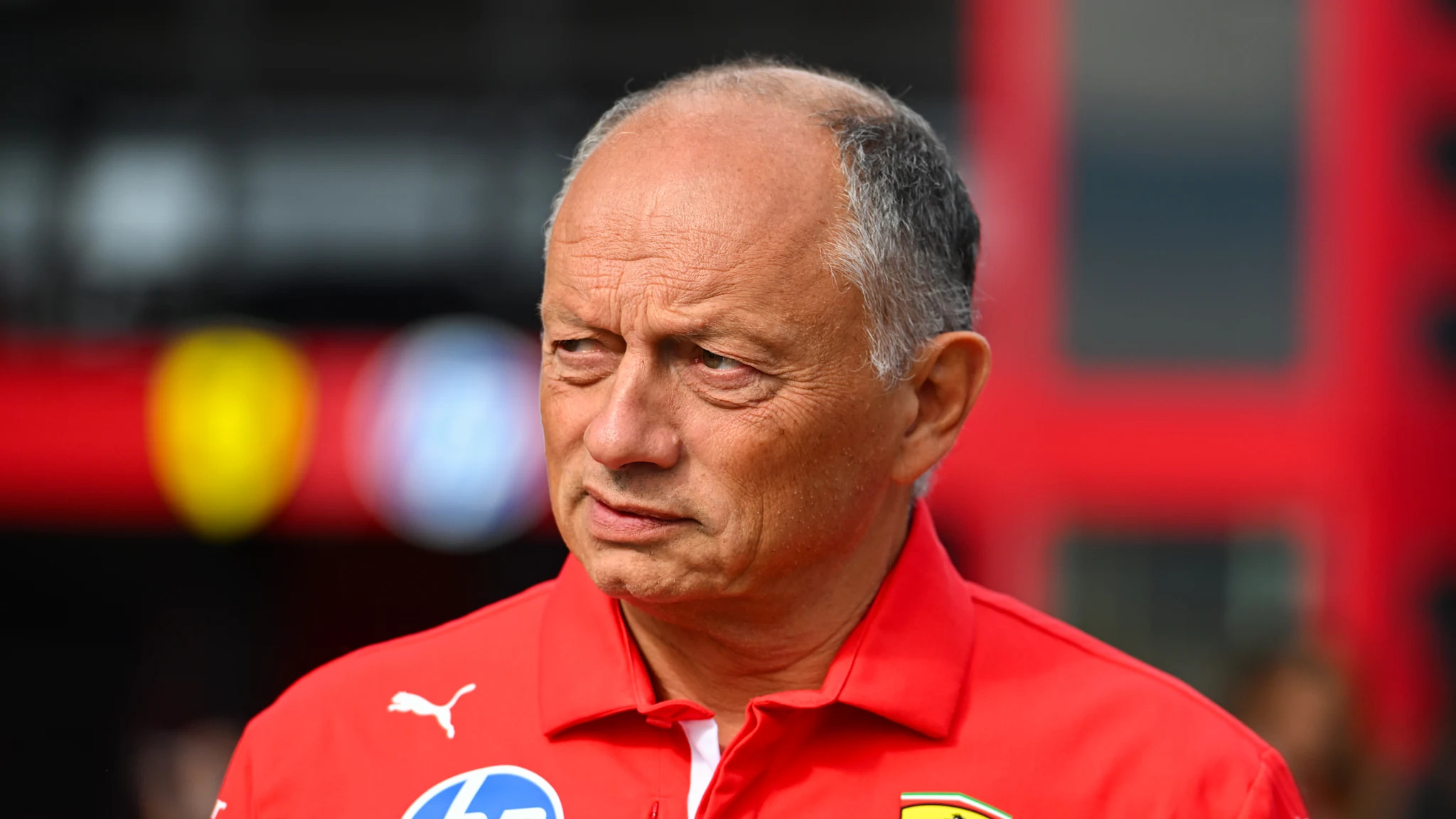 Image accompanying the official F1 announcement.
Ferrari left Baku with a results line of P4 for Charles Leclerc and P6 for Lewis Hamilton, but the weekend’s narrative underlined the gap between qualifying promise and race-day execution. Leclerc qualified second at the Azerbaijan Grand Prix, a performance Vasseur described as surprising for a team that has shown a straight-line speed deficit throughout the season. On race day, however, Leclerc slipped down the order early to P5 as he could not defend effectively, before an opening-lap sequence led into a mini sprint after the last Safety Car interlude.
Leclerc ultimately recovered to finish P4, with Vasseur pointing to the swing in his favour after Oscar Piastri made a mistake. Ferrari’s team result still fell short of their aspirations, particularly given that they have already won twice this season and Baku is a venue where Leclerc has often performed strongly. Hamilton’s outcome was similarly underwhelming, with the Briton finishing P6, and Vasseur said the overall weekend was not helped by challenges around tyre preparation.
Addressing the pace mismatch between qualifying and the race, Vasseur said Ferrari had known the opening laps—and restarts after a Safety Car—would be difficult. “Honestly, we were surprised to be on the first row, because it’s one is the most demanding on the engine, and we were not expecting to do so,” Vasseur said. He added that, starting from the front, the team had to focus on the realities of race conditions: “But we knew even starting from the first row that the opening laps, or in case of restarting after a Safety Car and so on, it would be difficult, and it was. But overall, I think that we maximised what we can do in Baku with P4 and P6.”
Vasseur stressed that the current target cannot be satisfied by those finishing positions, even if he framed them as the best possible outcome at Baku. “For us, we can't be satisfied with P4 and P6, but in Baku I think it’s the maximum.” He linked Ferrari’s difficulties in defending to the aerodynamic and set-up compromises required when straight-line speed is compromised. “The biggest limitation is that when you are in this situation and you want to defend, you go in a kind of negative spiral,” Vasseur said, describing how drivers may be pushed to run lower downforce than the optimum because defending requires a different balance, even though that costs lap time.
He cited Monza as a similar example where Ferrari’s qualifying and initial race pace were decent, but the team lost ground on the straights early in the race. “We had a similar case in Monza. There the pace was decent. The quali position was decent, but we were losing one position per straight line in the opening laps.” Vasseur then pointed to the upcoming calendar, saying the next races should be less demanding than Baku and expressing a desire to recover performance. “Let’s try to be back,” he said, arguing that there is also a shift in what can be improved faster.
According to Vasseur, the path to progress increasingly favours chassis development over engine-led changes as the season evolves. “There is also a kind of convergence on the chassis, you can improve much quicker than with the engine. There is a kind of convergence of performance on the chassis.” He also suggested that the competitive advantage Ferrari previously held in chassis performance is shrinking. “I think the advantage that we had on the chassis is smaller, or not there anymore,” he said, adding that rivals may be closing the gap with their own progress.
Leclerc’s frustration centred on Ferrari’s need for timely upgrades, and Vasseur responded directly with a promise to deliver improvements soon. “I won’t give you the date, but soon,” he said. He described a staggered approach across teams, noting other developments already being timed into recent races. “Now it’s like this that we are all bringing upgrades at different places. I think McLaren did something this weekend, and Merc it will probably be next weekend,” Vasseur said, referencing Malaysia and Petronas as part of that schedule.
Vasseur also acknowledged the complexity of development decisions as Formula 1 moves toward next year’s regulations. He said Ferrari is balancing immediate step changes with the need for fine-tuning, particularly as teams shift their focus toward the next-year programme while still making adjustments within ongoing continuity. “Sometimes you do steps, but it’s not always paying off, because sometimes you have to fine tune,” he said. “Now I think everybody is switching to the next year’s programme, because even if it’s into the continuity, we have some changes on the regulations, and we have to anticipate this.”
Reporting source: F1 official update