
Golden State Valkyries claim 2026 WNBA championship in record-setting run
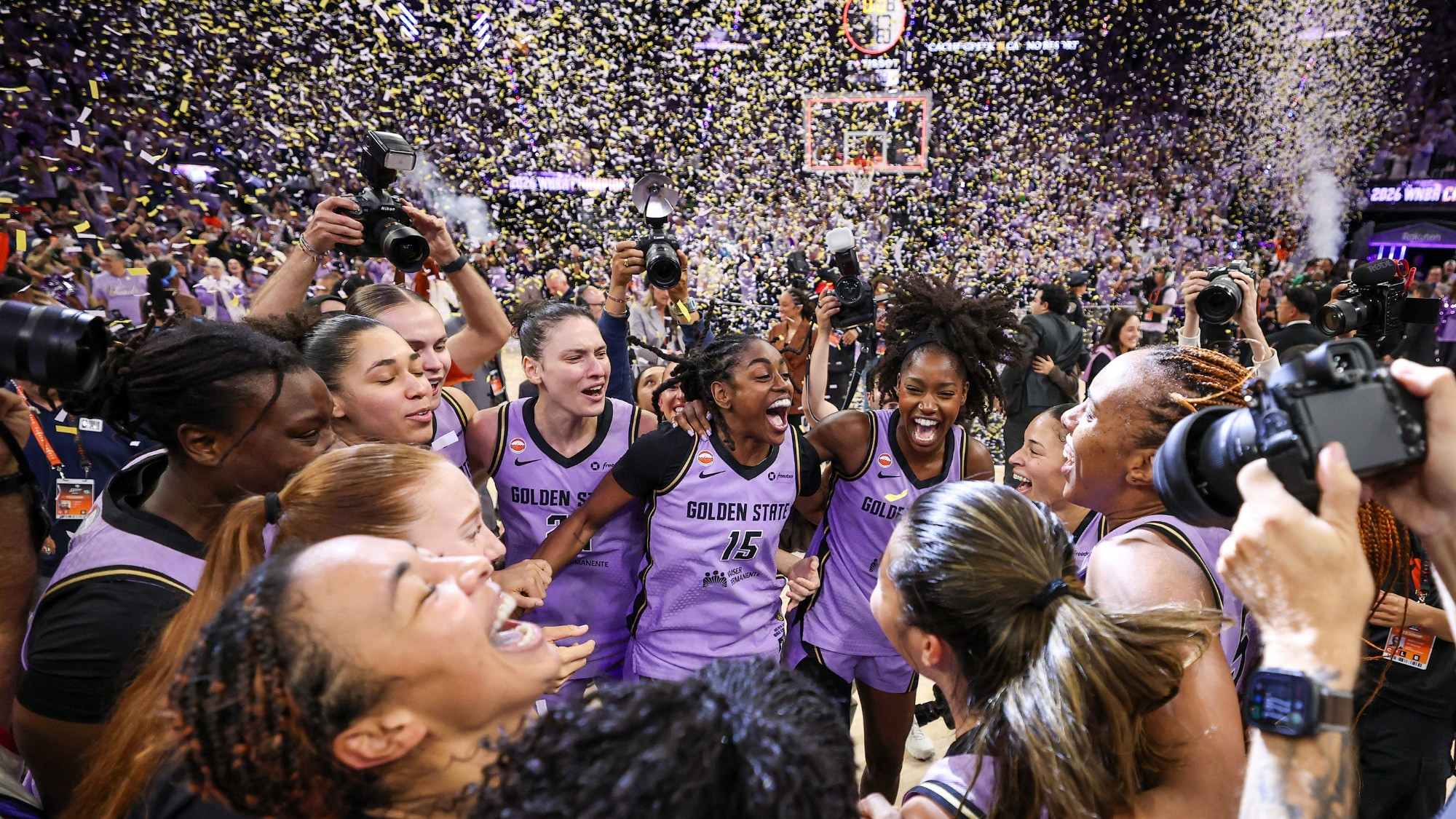 Image accompanying the official WNBA announcement.
The Golden State Valkyries captured the 2026 WNBA championship, celebrating after a Game 7 victory that brought confetti to Ballhalla, according to the WNBA’s own write-up of the title run.
The league’s recap framed Golden State’s championship as a milestone for expansion franchises: it is described as the fastest North American (NBA/NFL/NHL/MLB/WNBA) professional expansion team since 1967 to win a championship, doing so in its second year of existence. The team is also tied to an earlier ownership promise: the WNBA recap notes that Golden State owner Joe Lacob had described a championship within five years when the franchise was announced in October 2023, and that the title came three years ahead of that timeline.
In Golden State’s inaugural season, the WNBA recap says the franchise established its competitive identity under first-time head coach Natalie Nakase. It describes Nakase as having previously won two WNBA championships as an assistant with Las Vegas before taking the Golden State job, and it says the 2025 roster was assembled through the expansion draft, selecting players left unprotected by their former teams.
The WNBA recap places Golden State’s first-season results at 23-21 in the regular season and says the Valkyries became the first expansion team to make the playoffs in their inaugural season. It also states that Golden State fell in the opening round to top-seeded Minnesota.
Ahead of the 2026 season, the league’s recap says the Valkyries added Gabby Williams and Kiah Stokes to fit the defensive, depth-and-grit style already forming in Year 1. The WNBA recap states that Williams arrived coming off her second All-Defensive Team selection as the league’s steals leader in 2025, while Stokes arrived after winning her third title in four years with Las Vegas.
The WNBA’s account emphasizes that Golden State’s 2026 run was characterized by steadiness when results could have turned. It reports that in contrast to the end of 2025, when the Valkyries closed their inaugural season with five consecutive losses, Golden State did not lose three consecutive games from opening night of 2026 until the first-ever Game 7 of the WNBA Finals.
According to the league recap, Golden State faced potential three-game skids five times during the regular season and postseason, but avoided each. It highlights that the most critical instance came in the Finals after Golden State fell behind 2-1 in the series, before winning the remaining games.
The WNBA recap connects those avoided slides to specific opponent stretches, citing games against Phoenix, Atlanta, Toronto and Minnesota during the regular season, and again against Atlanta in the Finals. It adds that Golden State went 5-0 across those situations and won by an average margin of 10.6 points in those games, while also citing defensive results in that same timeframe: opponents were held to 70.8 points on average.
Defense is presented as the central theme in the league’s explanation of the championship. The WNBA recap says Golden State led the WNBA in defensive rating in 2026 and provides a figure of 99.1, described as 4.2 points per 100 possessions better than the next-best defense. The recap also includes comparative context, noting that the gap between second and seventh in defensive rating was smaller than the gap between Golden State and the runner-up.
The league’s write-up credits Stokes as a defensive anchor and links her to multiple markers. It reports that Stokes ranked fourth in the WNBA in blocks per game at 1.7 and held opponents to 38.3% shooting at the rim, citing Synergy Sports. It also attributes perimeter pressure to Williams and Veronica Burton, stating that Williams ranked fourth in steals per game at 1.64 and Burton ranked ninth at 1.57.
As part of the season-ending honors, the WNBA recap states that Burton and Stokes earned Second Team All-Defensive honors, while Williams was named to the First Team and finished as Defensive Player of the Year runner-up. It further notes that Burton, Stokes and Williams all ranked in the top 10 in defensive win shares, listed in the recap as 2.99 for Stokes, 2.57 for Williams and 3.08 for Burton.
The WNBA recap also frames Golden State’s title as historically distinct in how it was built and produced scoring. It says Golden State became the first team in league history to win the championship without an All-WNBA honoree on its roster during that same season. It contrasts Golden State’s roster against the Finals opponent, the Atlanta Dream, describing Atlanta as having two All-WNBA selections and three All-Stars.
In addition to All-WNBA absence, the recap says the Valkyries won without a top-20 regular-season scoring leader on their roster. It states that Williams was Golden State’s leading scorer at 14.4 points per game and ranked 32nd in the league. It also states that only four previous champions had a leading scorer ranked outside the top eight.
To explain the offensive framework behind the championship, the WNBA recap highlights the team’s bench production. It reports that Golden State reserves set a WNBA record for bench scoring, averaging 35.9 points per game during the regular season, described as 7.4 more points than any other bench unit in the league that year. The recap identifies Janelle Salaun as the unanimous Sixth Player of the Year at 12.7 points per game, along with Tiffany Hayes at 8.9 points per game and Kaitlyn Chen at 7.2 points per game, and it says those players ranked in the top eight in bench scoring among reserves with at least 20 games.
The league’s write-up adds that in the playoffs, when rotations tighten, Golden State’s reserves still accounted for a substantial portion of scoring, totaling 25.7 of 76.5 points per game, or 33.6%, during the postseason. It ties the bench’s role to Golden State’s ability to manage different matchups and keep production spread across lineups.
Pace control is another theme in the recap’s description of how Golden State handled high-scoring opponents. It states that the Valkyries forced the Las Vegas Aces and Atlanta Dream to play at Golden State’s pace, which the recap says was the slowest in the WNBA during the regular season, at 75.66 possessions per 40 minutes.
In the semifinals, the WNBA recap says Golden State limited the Aces to 72.7 points per game while also reducing possessions to 72.64 possessions per 40 minutes, described as nearly eight fewer possessions than Las Vegas averaged in the regular season. In the Finals, it says Golden State held Atlanta to 71.4 points per game and 75.36 possessions per 40 minutes, described as six fewer possessions than Atlanta averaged during the regular season, and it notes that Golden State’s Finals pace (75.36) was close to its regular-season mark (75.66).
The WNBA recap also points to performance in close games and clutch-time swings. It says Golden State finished the regular season 32-12 but posted a 9-9 record in games featuring clutch time as defined by the league (score within five points in the final five minutes), with a plus-1 point differential over 18 such games.
In contrast, the recap reports a turnaround in the playoffs, with Golden State going 6-1 in clutch games and outscoring opponents by a plus-24 point differential. It says three of those clutch-game wins came in the Finals as Golden State went 3-0 in games that came down to the wire, described as a plus-18 point differential in those contests.
Within that clutch-time framework, the WNBA recap describes “Gabby Time” and details Williams’ Finals impact. It says Williams posted a 42.4% usage rate in clutch situations for the series and outscored Atlanta 17-11 during clutch time. It also cites specific moments in Game 1 and Game 7, including Williams scoring eight points in the final four minutes of Game 1 and in Game 7 hitting a 31-foot three with 2:18 remaining, after nine clutch points.
The league’s write-up further says Williams finished with 28 points in the second half of Game 7 to set a WNBA playoff record for most points scored in any half, breaking a previous mark held by Angel McCoughtry. It concludes that the performance secured the Finals MVP trophy for Williams and adds that, after averaging 14.4 points in the regular season, Williams averaged 21.0 points per game during the playoffs, according to the recap.
Reporting source: WNBA official update