
Rays vs. Brewers 2026 World Series: MLB’s position-by-position matchup breakdown
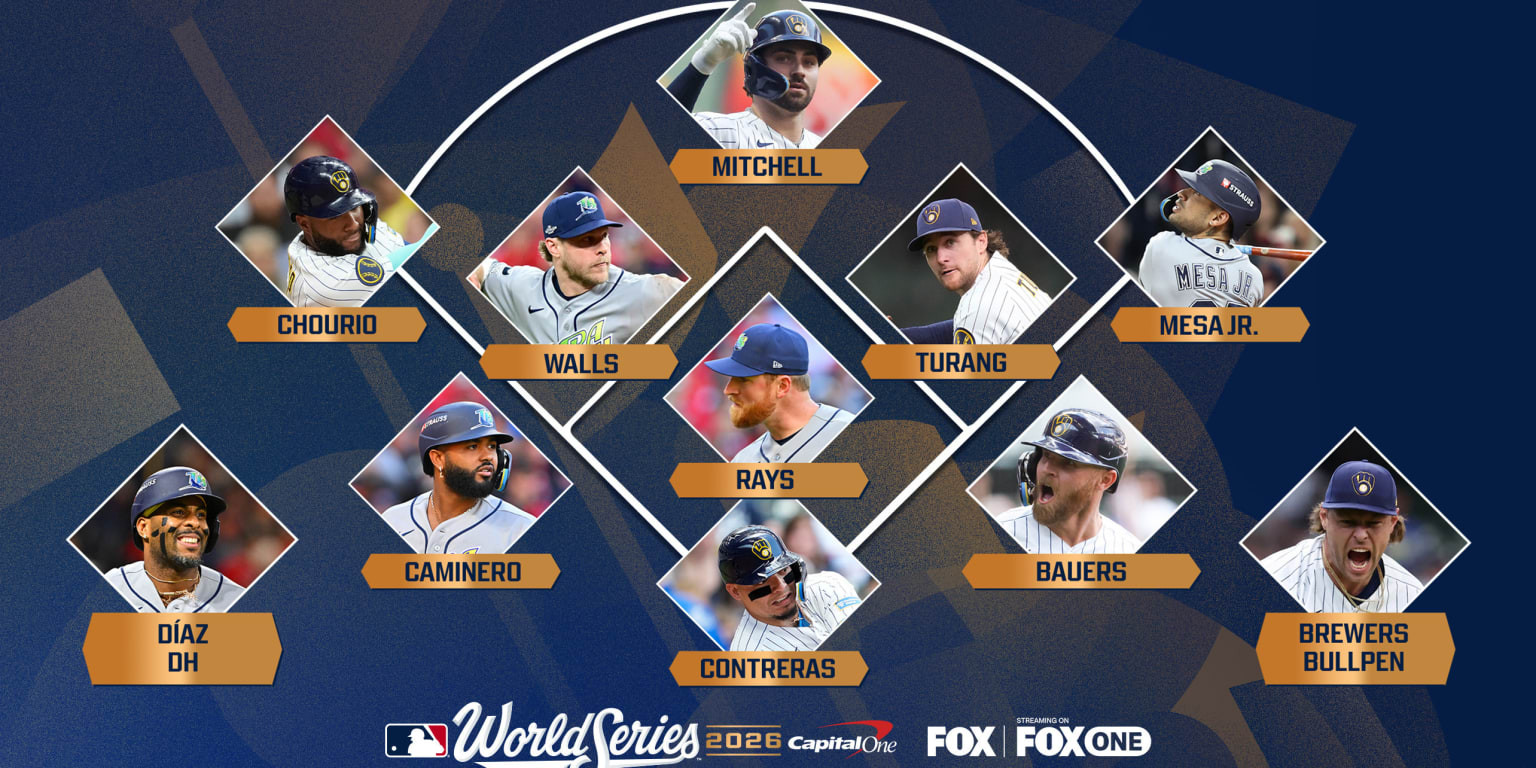 Image accompanying the official MLB announcement.
A 2026 World Series matchup between the Tampa Bay Rays and Milwaukee Brewers is framed by MLB as a rare “No. 1-vs.-No. 1” pairing, and also as the sixth time in the past 30 years that the championship series has brought together teams ranked No. 1 on their respective paths. MLB’s breakdown also notes that both fanbases have never won before, making this the first such World Series pairing since 1980, when the Kansas City Royals played the Philadelphia Phillies, and only the second time in more than a century that neither side had previously captured the title.
MLB’s preview highlights multiple connections between the franchises and players. It points to Tampa Bay’s top two starters, Drew Rasmussen and Freddy Peralta, both coming through Milwaukee and being teammates on the 2020–21 Brewers. It also notes that NLCS MVP Jake Bauers made his Tampa Bay debut in 2018, and that Milwaukee president of baseball operations Matt Arnold spent nine years in Tampa Bay’s front office before moving to Wisconsin. Beyond those links, MLB describes the matchup as a “throwback” in style, where both clubs rely on analytical thinking but also emphasize a style of baseball that can translate into similar game plans.
According to MLB’s analysis, the Rays and Brewers finished with overlapping profiles in multiple team skill sets. It states that no team struck out less than Tampa Bay, that both teams landed in the top five in steals, and that both also finished in the bottom 10 in home runs. MLB adds a specific comparative note on bunting that says Tampa Bay ranked first and Milwaukee ranked second in the bunt-hits leaderboard. The preview further describes both teams as carrying strong defensive profiles, setting up expectations for a series that, in MLB’s framing, should feature high-level execution rather than an emphasis solely on power.
From the catcher position, MLB’s breakdown centers on William Contreras for Milwaukee and Liam Hicks for Tampa Bay. It says Contreras has a strong all-around argument over the past five years as one of the best NL catchers, while also pointing to a decline from his peak offensive stretch in 2022–24 as indicated by 110 OPS+ over the last two seasons. MLB also references Contreras’ performance in eight playoff games, citing a 1.157 OPS with three home runs, and it credits Tampa Bay’s midseason acquisition of Hicks for strengthening Milwaukee’s opposition lineup, while stating Hicks has not produced much at the plate in the playoffs. Based on the comparison, MLB lists “Advantage: Brewers” for the catcher matchup.
MLB’s next pairing compares Jake Bauers for Milwaukee with Jonathan Aranda for Tampa Bay at first base. It describes Aranda’s breakthrough season last year as arriving about a decade after he signed as an amateur free agent with Tampa Bay, and it says MLB views Bauers as holding the offensive edge in both power and reaching base, while adding that neither player is portrayed as a particularly strong defender. MLB’s breakdown attributes a larger advantage to Milwaukee for this matchup, calling attention to Bauers’ 2026 regular-season edge and stronger October performance.
Second base is portrayed as the most lopsided matchup in MLB’s evaluation. Brice Turang is singled out as the “best all-around second baseman” in the game in the breakdown, with MLB pointing to both defense and more recently found power, including 21 homers and 100 RBIs in the regular season. MLB contrasts that with Tampa Bay’s second-base value coming through a duo of Richie Palacios and Ben Williamson, describing it as a below-average spot for Tampa Bay and concluding that the comparison goes Milwaukee’s way.
At shortstop, MLB’s preview puts Tampa Bay’s Taylor Walls against Milwaukee’s Cooper Pratt. MLB emphasizes that Tampa Bay continues to play Walls every day despite near-total lack of offense from the position, citing that he posted a .381 OPS “this month” and describing his overall career hitting as routinely ineffective. It also notes that the preview expects Pratt to be a quality shortstop as he develops, but it credits Walls with the edge for postseason reliability based on “important miscues” attributed to Pratt in October. MLB frames this as yet another “Advantage” call that favors Tampa Bay at shortstop.
Third base receives a more star-driven comparison between Tampa Bay’s Junior Caminero and Milwaukee’s Garrett Mitchell at corner-infield roles in MLB’s breakdown. MLB describes Caminero as posting a second consecutive 40-plus homer season and frames him as a likely high finisher on AL MVP ballots. It acknowledges that his October output was quieter until a key ALCS Game 6 homer and also characterizes the sample size as limited to eight games against top pitching. For Milwaukee, MLB notes speed-and-defense attributes tied to David Hamilton and Joey Ortiz, but still portrays the talent tier at third as favouring Tampa Bay through Caminero’s overall upside.
MLB also extends the matchup contrast to the outfield and notes big-picture differences in how each team creates value. For left field, it compares Jackson Chourio’s 22-year-old power-and-defense profile against Chandler Simpson’s 25-year-old speed-and-contact profile, while stating that both were named Gold Glove finalists last week and referencing Chourio’s history of three 20-20 seasons through age 22. MLB characterizes the final edge as tipping toward Chourio’s combination of fielding, running, and the presence of power, given that only one of the two is described as delivering notable power.
In center field, MLB pairs Tampa Bay’s Garrett Mitchell and Jonny DeLuca, describing both as strong defenders but suggesting the edge to DeLuca. MLB attributes part of that to a distinction in how each player reaches base, noting Mitchell struck out more while DeLuca is presented as less of a walk-and-obtain-base threat in comparison. For right field, MLB compares Milwaukee’s Sal Frelick—described as having a relatively weaker season by OPS+—with Tampa Bay’s Victor Mesa Jr., which MLB characterizes as a breakout performer in a half season with the Rays and credits with strong defensive impact and a 127 OPS+.
The preview also covers the designated hitter role and starting pitching. At DH, MLB’s breakdown names Yandy Díaz for Tampa Bay and Christian Yelich for Milwaukee, arguing that Díaz outperformed Yelich in the regular season (124 OPS+ versus 91 OPS+) and carried that into the postseason, while Yelich’s usage is described as being influenced by left-handed matchup plans. For starting pitching, MLB lists Milwaukee’s Jacob Misiorowski, Logan Henderson, and Robert Gasser against Tampa Bay’s Drew Rasmussen, Freddy Peralta, and Nick Martinez, adding that the six combined for a 1.87 ERA so far in the playoffs while also suggesting that underlying strikeout performance has been only “average.” MLB’s conclusion for the rotation emphasizes Tampa Bay’s depth rather than just top-end dominance, pointing out that no Milwaukee starter has gone beyond five innings in the playoffs to date and tying that to a bullpen pressure scenario.
Finally, MLB’s bullpen and overall-series assessment in the breakdown compares Milwaukee’s relievers—highlighting that the Brewers bullpen has allowed six earned runs in 40 2/3 postseason innings and describing an emphasis on velocity among several arms—against Tampa Bay’s bullpen, which it describes as good but not throwing as hard overall. MLB also notes a status angle regarding Bryan Baker, indicating his fastball velocity dipped below 93 mph in ALCS Game 6 after heavy usage against Cleveland. The breakdown closes by characterizing the matchup as tightly matched and listing several “small edges,” ending with a series prediction of “Brewers in seven.”
Reporting source: MLB official update