
MLB highlights 11 top Statcast moments from the 2026 postseason, led by Jackson Chourio’s triple-digit walk-off
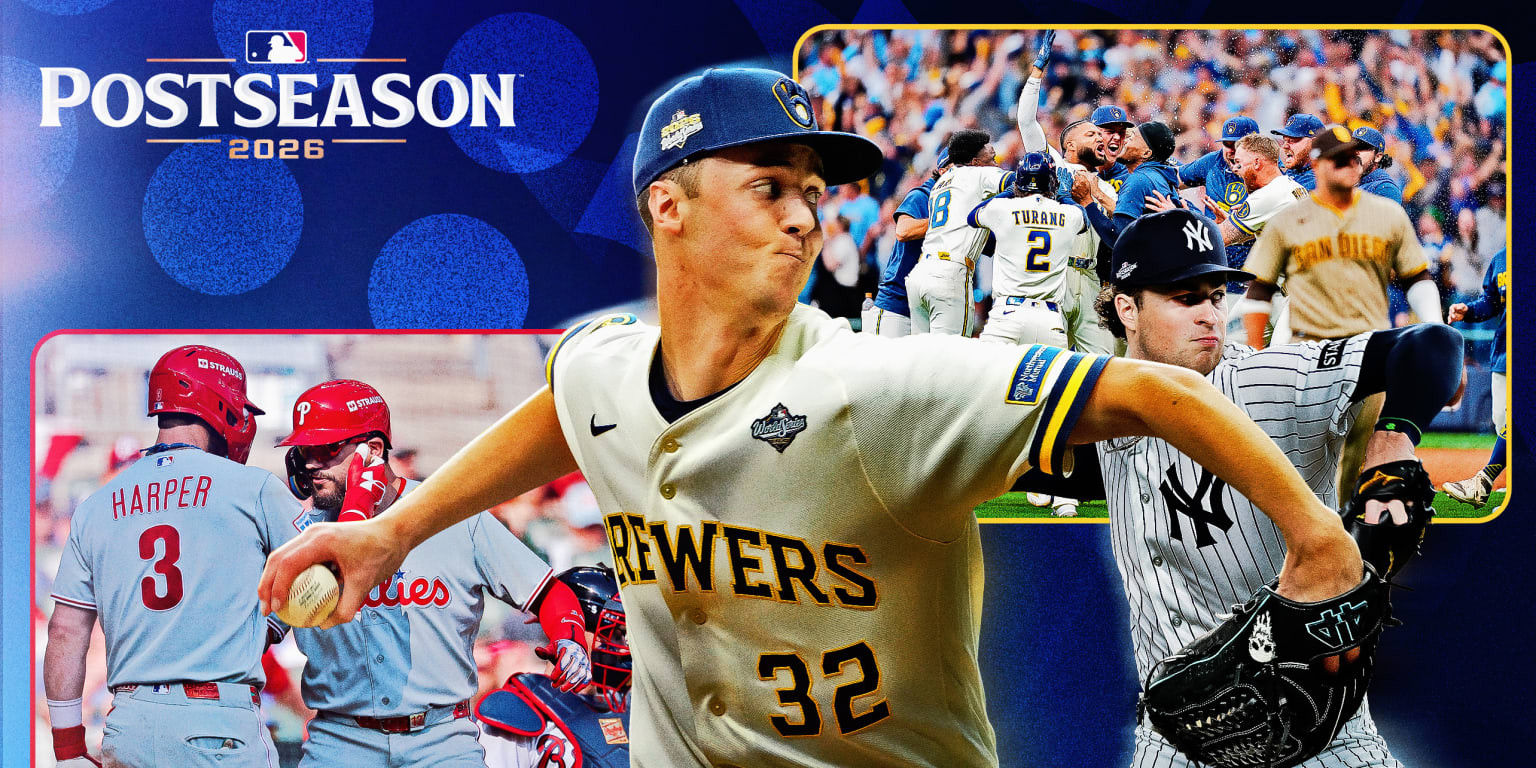 Image accompanying the official MLB announcement.
Major League Baseball has unveiled a Statcast-powered showcase of the most dramatic “metrics” from the 2026 postseason, naming 11 standout moments driven by pitch tracking and batted-ball tracking data. The feature, produced with Statcast powered by Google Cloud, credits the postseason’s defining plays to a mix of record-setting velocity, rare pitch locations, and game-changing batted-ball outcomes—beginning with what MLB describes as the single biggest impact play on the road to the World Series.
The top moment in MLB’s list is the “Chourio walk-off,” tied to Jackson Chourio’s decisive late-inning hit for the Milwaukee Brewers. MLB’s Statcast summary places the scene in Game 2 of the NLDS, with Milwaukee facing the San Diego Padres, two outs in the bottom of the ninth, and the bases loaded when Chourio turned around a 101.3 mph fastball from Padres closer Mason Miller. MLB’s tracking description says Chourio’s walk-off single came off a 109.5 mph pitch, and it frames the hit as the only triple-digit-heater walk-off single in postseason history within the pitch-tracking era that dates to 2008, noting that the next-fastest walk-off pitch on record was 99.5 mph for Jimmy Rollins in the 2009 NLCS.
MLB’s list also spotlights Jacob Misiorowski’s postseason velocity, describing it as record-setting at both the postseason and World Series level. According to the feature, Misiorowski—identified by MLB as a Brewers ace—threw the fastest postseason pitch of the pitch-tracking era on his first playoff pitch, topping out at 104.8 mph and surpassing Miller’s 104.5 mph mark from the previous October. MLB’s Statcast recap adds that his very first pitch of the World Series reached 103.5 mph, which it credits as the fastest World Series pitch of the pitch-tracking era, breaking Aroldis Chapman’s 103.2 mph standard from 2016.
On the running and celebratory side of the power moments, MLB highlights Junior Caminero of the Tampa Bay Rays for what it calls the longest home run trot in the Statcast era. MLB says Caminero’s celebration after his first postseason home run featured a 38.66-second trot, recorded after a home run off Guardians closer Cade Smith that MLB says helped send Tampa Bay to the World Series. In MLB’s accounting, the 38.66 seconds is the longest postseason home run trot in the Statcast era (since 2015), with MLB noting that including the regular season the only longer trot belongs to Caminero earlier in September at 40.65 seconds.
The feature then turns to Shohei Ohtani, highlighting what MLB describes as a cathartic return to home run impact. MLB states that Ohtani had not homed since Aug. 18 until his postseason resurgence in the NLCS. MLB’s Statcast description specifies a three-run homer in Game 4 of the NLCS while Ohtani was with the Los Angeles Dodgers, hit off a 95.1 mph cutter from Dustin May. MLB quantifies the result as 113.1 mph off the bat, traveling 428 feet into right-field at Dodger Stadium, and it adds that the blast ranked as the second-hardest home run of the 2026 postseason.
Rounding out the Brewers theme from the lead item, MLB also places a team emphasis on Milwaukee’s bullpen performance. The list calls it “unbeatable” and frames it as one of the most dominant playoffs on record in terms of late-game leverage outcomes. MLB names specific relievers and their Statcast-driven signatures, including Trevor Megill closing out a World Series win with an 88.6 mph, 2,832 rpm curveball strikeout, and Aaron Ashby posting what MLB describes as a reliever-best single postseason value in the pitch-tracking era, citing 18 scoreless innings and a total of +10 runs prevented for Milwaukee.
MLB’s compilation also highlights two of the lowest pitches for home runs it says were seen in the postseason—both of which it describes as “off the shoetops” decisions in winner-take-all situations. The feature credits José Ramírez for a tying, scoreless-breaking homer against the White Sox in Game 5 of the ALDS, described as a homer off a Sean Burke curveball that MLB says was just 0.74 feet off the ground. It then credits Michael Harris II for a winner in the NL Wild Card Series, describing a homer in Game 3 of that series off an Aaron Nola fastball that MLB says was 1.11 feet off the ground.
Two additional entries emphasize pitching command and swing-and-miss outcomes, framing them as “unhittable arsenals” featuring no-hit bids from both sides of the bracket. MLB’s Statcast recap credits Rays ace Drew Rasmussen for a dominance stretch against the New York Yankees in Game 1 of the ALDS, and it credits Padres ace Michael King for a comparable performance against the Chicago Cubs in Game 1 of the NL Wild Card Series. MLB quantifies Rasmussen’s swing-and-miss rates as over 40% across three pitch types—fastball (50%), cutter (41%), and changeup (56%)—and says he recorded 23 total whiffs. For King, MLB says his signature sweeper jumped by 2.5 mph in velocity and 142 rpm in spin compared to his regular-season form, averaging 84.5 mph and 2,970 rpm, and it notes three strikeouts against the Cubs within the described effort.
The list includes a late-game “go-ahead” homer for the Atlanta Braves as another highlight of pitch velocity under pressure. MLB describes Austin Riley’s three-run home run in Game 1 of the Wild Card Series, where Atlanta faced the Philadelphia Phillies and dealt with a late-game deficit. MLB’s Statcast description says Riley crushed a dramatic go-ahead homer off Phillies closer Jhoan Duran, hit off a 99.9 mph heater. It credits the moment as the second-fastest pitch hit for a go-ahead home run so late in a postseason game in the pitch-tracking era, with MLB citing Mike Brosseau’s 100.2 mph homer off Chapman in Game 5 of the 2002 ALDS as No. 1.
MLB’s compilation also singles out another marquee matchup involving Chris Sale and Bryce Harper to open the NL Wild Card Series. MLB states Sale reached triple-digit velocity to strike out Harper, describing the strikeout as a 100 mph pitch at age 37—while it also notes Sale’s last triple-digit strikeout came in the summer of 2018. In a further sign of how far each entry ranges from pitching to power, the list then turns to the Boston Red Sox’s playoff dominance over the New York Yankees via Cam Schlittler, crediting him with 10 strikeouts and 24 whiffs in a Wild Card Series start at Yankee Stadium.
Finally, MLB’s list closes with a power-sequence moment from the Phillies, pairing Kyle Schwarber and Bryce Harper for back-to-back homers. MLB states the two Philadelphia sluggers delivered consecutive drives off Braves reliever Dylan Lee in a winner-take-all Game 3 of the Wild Card Series after Philadelphia trailed by two runs in the eighth and faced elimination. MLB’s tracking summary says the two swings produced a combined 865 feet of home-run distance—447 feet for Schwarber, described as the longest home run of the 2026 postseason, and 418 feet for Harper.
Taken together, MLB’s Statcast compilation uses pitch velocity, pitch type movement, swing-and-miss outcomes, launch measurements, and timing to link key playoff swings to measurable traits. The feature’s organizing principle is not a game recap, but a metrics-focused selection of the moments MLB identifies as most extreme across speed, timing, and batted-ball impact during the 2026 postseason.
Reporting source: MLB official update