
MLB general managers talk “small ball” after Brewers’ 2026 World Series run
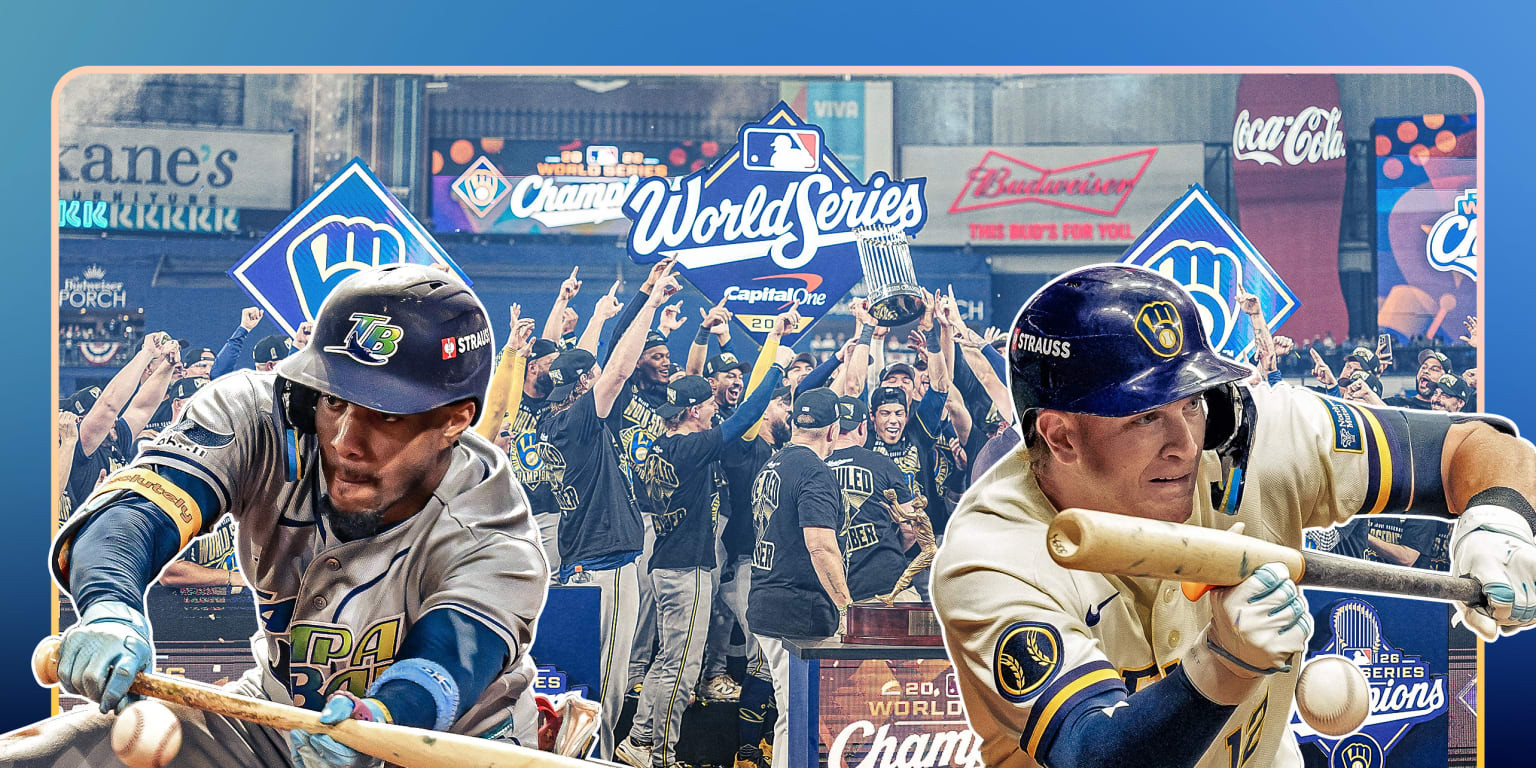 Image accompanying the official MLB announcement.
The conversation around MLB’s 2026 champion shifted quickly from celebrating a title to debating how it was won as league executives gathered for the General Managers Meetings earlier this month. In a scene described from those meetings, Cardinals president of baseball operations Chaim Bloom discussed the state of his club while the Brewers’ leadership—paired with Milwaukee’s status as the newly crowned World Series champion—moved the topic toward the Brewers’ unconventional offensive profile.
Bloom referenced the World Series trophy and Milwaukee’s achievement directly while speaking at the meetings, indicating a desire to be in that position and drawing attention to the “small-market” context of the Brewers’ run. The discussion, as framed in the league’s meeting setting, centered on whether other organizations might “take note” of a team that reached and won the Fall Classic with an approach built more around speed and precision than on traditional power emphasis.
The Royals also weighed in with a view that aligns with the Brewers’ style as described. “It’s good baseball,” Royals GM J.J. Picollo said, describing how even in successful seasons—he cited Kansas City’s 2014 and 2015 run—winning often comes from finding ways to handle the reality of low-scoring games, where teams frequently face one- or two-run margins rather than consistently producing blowouts through multi-run home runs.
While Picollo pointed to the importance of sound defense and strong pitching as recurring advantages across eras, the thrust of the meeting discussion was the offensive model credited for Milwaukee’s championship. According to the league context provided at the meetings, the Brewers were described as a throwback offensively, leaning on speed and precision rather than power, even though baseball’s broader modern emphasis has often leaned toward hitting more home runs.
The source ties that approach to measurable results from recent seasons and postseason context. It says Milwaukee finished each of the last two seasons with MLB’s best record, despite ranking 22nd and tied for 28th, respectively, in home runs among the 30 teams over those two years. It further notes that the two World Series participants in 2026 ranked in the bottom 10 in MLB in home runs, while also ranking in the top three in bunt hits, reinforcing the idea that the championship run was not powered primarily by long-ball volume.
The meeting setting also included a skeptical, contrasting voice from another club executive. Marlins president of baseball operations Peter Bendix was described as responding with sarcasm to the idea that teams should copy what the winner did, while the overall framing continued to ask whether “small ball” could be made a more prominent strategy after the Brewers’ success.
Beyond the discussion of philosophy, the source offers detailed postseason-oriented indicators that place Milwaukee’s run inside broader postseason patterns. It states that the Brewers outhomered their opponents in every series of their postseason advancement. It then says that this matched a postseason trend in which 84% of games were won by the team that outhomered the other, suggesting that while Milwaukee’s overall offensive identity included contact and speed, it still produced home-run outcomes when it mattered.
The league context provided further characterizes Milwaukee’s October home-run rate and run prevention. In October of the 2026 season, the Brewers hit a home run once every 34 at-bats, and the source says that in the Wild Card era there have been multiple World Series-winning teams with worse postseason home-run rates. Where Milwaukee is described as an anomaly, the source says, is in limiting opponents’ power; it reports that Milwaukee held opponents to 0.31 homers per nine innings, which it calls the best such rate by a World Series champion pitching staff since the 1985 Royals.
The meeting conversation then broadened from replicating a single formula to understanding what aspects of Milwaukee’s offensive profile might carry over. Picollo’s remarks are presented as a callback to the idea that not every club can build deep 1-through-9 pitching and star-heavy lineups, and instead must find ways to create runs through athleticism. He said the approach that works is having “four or five really good hitters” while using athletic players to create runs in multiple ways.
The source also links modern offensive decision-making to the sport’s current environment. It says that athleticism has increased in importance during the pitch-timer era, citing a faster pace and changes that have incentivized stolen bases. It adds that as pitcher velocity has risen, younger hitters who have faced extreme velocity from an early age and possess bat speed to match that velocity are being rewarded more than some older counterparts.
In that context, the source provides youth-oriented hitting indicators from 2026. It says hitters aged 20–25 posted a higher batting average (.247) than hitters aged 30–35 (.238). It also reports that the 20–25 sample was four points below the overall group average for that age, while the 30–35 output was 14 points below its norm and described as the lowest average on record for that age group.
The Brewers, Rays, and Guardians are then described as having ranked in the lower half of MLB in average batter age in 2026, with the Rays at 27.8 (14th), the Brewers at 27.4 (12th), and the Guardians at 27.0 (ninth). That framing reinforces how the style discussed at the meetings is presented as more compatible with the player profiles these teams featured during the year.
One theme the source emphasizes is that Milwaukee’s success may be less about broad categories like “small ball” and more about specific swing and batted-ball choices that contrasted with league-wide trends. It says Milwaukee and the Rays ranked first and second in MLB in the percentage of batted balls that went to the opposite field, presenting that as a key differentiator in how their offense produced results.
At the same time, the source cautions against treating the Brewers’ approach as a guaranteed template for the future. It attributes that caution to a comment from Matt Arnold, the Brewers’ counterpart in the meeting setting, who said teams experience “ebb and flows” and that different offensive constructs can look one way at one point and then change later. Arnold also said he loves home runs and expressed the uncertainty of whether the 2026 offensive path represents a long-term trend, even as it delivered results in that season.
The meeting discussion also touches on the reality that not every winning path looks like Milwaukee’s. It points to the White Sox as a regular-season example built around power, describing the club’s strikeout and homer rates and noting that while their October run ended without translating the same success, their regular-season win surge was tied to aggressive offense. White Sox GM Chris Getz is then presented as saying the organization is aiming to improve contact without sacrificing slug-related strengths and hinting at changes to how analytical information reaches players.
In the final part of the meeting framing, the source links Milwaukee’s offensive model to its player development and roster decisions, including its handling of NLCS MVP Jake Bauers, who it says parlayed his breakout into a four-year, $58 million contract with the Red Sox. The overall takeaway set up by the source is that while the Brewers’ championship formula appears rooted in contact-driven offense and athleticism, translating it to a different organization is difficult, and what worked in 2026 may not work the same way in 2027, even if the broader “small ball” conversation is gaining traction.
Taken together, the discussion at the General Managers Meetings positions Milwaukee’s 2026 title as more than a feel-good story: it becomes a high-visibility case study for executives trying to decide which offensive levers can be adjusted quickly in an era shaped by pitching velocity, pace changes, and player age curves—while acknowledging that baseball’s success still depends on fit, adjustments, and timing as teams chase their own October outcomes.
Reporting source: MLB official update