
The “Risk Perspective” on how F1 teams tackle the Circuit of the Americas
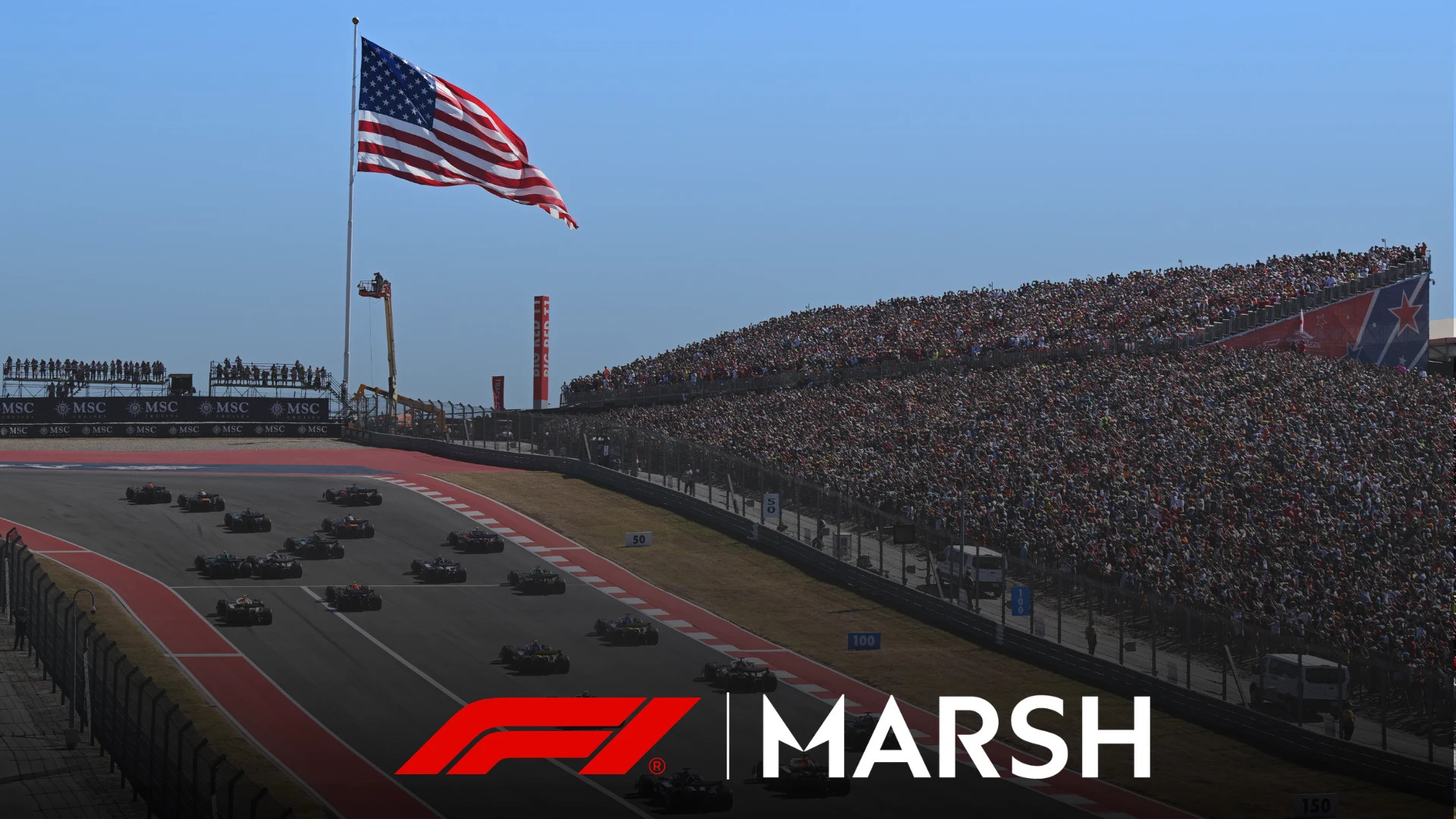 Image accompanying the official F1 announcement.
Formula 1’s “The Risk Perspective,” in partnership with Marsh (Formula 1’s Official Risk Partner and Official Insurance Brokering Partner), presents Circuit of The Americas as a track where small changes in conditions can quickly flip what is fastest—and what is safe. The series characterizes Austin as a “tent-pole” event that tests teams with an immediately changing environment, where performance can be decided in short, consequential moments rather than sustained advantage.
COTA’s layout forces F1 cars to do conflicting jobs on the same lap, according to the feature’s risk framing. The track is described as very fast but also bumpy, with the first sector demanding a car that works well in high-speed, while later parts of the lap want a different balance focused on low-speed efficiency. Formula 1 notes that this makes a single compromise setup inevitable, rather than one answer that suits the entire lap.
Xavi Marcos Padros—described in the feature as having worked in F1 with HRT, Williams and Ferrari, and later serving as chief race engineer for Richard Childress Racing in NASCAR—sets out how teams approach the technical side of those trade-offs. He joined Cadillac in 2025 to work on WEC and IMSA programmes and has since become chief race engineer for the Cadillac F1 Team, and he is quoted on how COTA’s sector demands create “good questions” for setup with “no obviously right or wrong answers.”
In Padros’ explanation, the rough surface shapes what the team discusses even if it does not change the fundamental nature of the set-up problem: teams still aim to maximize what they have within the circuit’s limitations. He says their discussions typically cover damper settings and general stiffnesses to cope with bumps, while also focusing on ride-height and, during the race, ensuring legality after wear to the plank measured post-race to confirm minimum ride height.
For the weekend plan, Padros describes an initial setup for FP1 built from simulator and simulation data, followed by adjustments after FP2 based on what the team sees in FP1. The feature adds that teams use simulator work overnight on Friday to optimize for Saturday’s action, while still factoring drivers’ feedback into whether the car can run stiffer or needs to be softer.
The feature highlights why qualifying is particularly risky at COTA, emphasizing tyre thermal management across the lap. Padros says the lap is tough on tyres and that out-laps can prepare the first sector but then leave tyres overheating later, making the final part of the lap difficult—especially with the left side of the car in long right-hand corners. He describes a potential compromise: running the first sector with tyres that are not fully up to temperature so they are better prepared for the end, while noting the challenge of deciding which approach will be best.
Padros also explains how teams attempt to reduce that uncertainty by practising on Friday with different out-lap approaches, then using a cross-car test to plan final qualifying simulation work in FP3. The feature frames the timing as a moving target because “rubber will go down, grip will increase and the track will evolve,” which can shift what teams expect from one session to the next.
From a strategy perspective, the feature says COTA has often been “on the cusp” between one and two stops, citing past outcomes across multiple years. Between 2021 and 2023, the race is described as producing two-stop results with sequences of medium>hard>hard (2021), medium>hard>medium (2022) and medium>medium>hard (2023). In 2024, the feature says it became a medium>hard one-stop race, after Pirelli tried a compound bridge strategy using C1-C3-C4 rather than the usual C2-C3-C4 for an expected “tortoise-and-hare” rivalry between steadier one-stoppers and faster two-stoppers.
According to the feature, that plan did not materialize as hoped: the 2024 US Grand Prix is described as “entirely a one-stop affair” on softer tyres, with Max Verstappen winning on a medium>soft race. For 2026, the feature states Pirelli has returned to the conventional C2-C3-C4 approach and notes that race-day temperatures—Texas in late October can go either way—can influence degradation and therefore whether a two-stop race becomes more likely. The feature adds that two-stop races have been rare in 2026.
The weekend’s driver substitution is also presented as a practical risk-management item for teams. The feature says Colton Herta, Cadillac’s test and reserve driver, will take part in FP1 at this event, substituting for Sergio Perez for one of the team’s mandatory rookie sessions. It also states this is Herta’s fourth FP1 session of the season, and that he has previously appeared in Barcelona, Budapest and Monza. The feature characterizes Herta as having extensive IndyCar experience, including seven series, nine wins, and second in the 2024 Championship, adding that his first IndyCar victory came at COTA in 2019, when he became the youngest driver to win in IndyCar.
Herta’s remarks in the feature focus on the balance between ride heights and stiffness to handle COTA’s bumps, while still delivering performance through the high-speed first sector and longer, slower corners. He also points to wind as a factor that can change which parts of the track teams can maximize, and he stresses that the circuit’s corner mix means drivers never feel completely comfortable throughout a lap, requiring a mindset built around compromise rather than perfection.
Finally, the feature spotlights Turn 19 as the corner that “does the heavy lifting.” It is described as a quick, open left-hander turning through 90 degrees with a tendency to fling cars wide into run-off, with entry slightly downhill and difficult to judge. The feature says Turn 19 comes late in the stadium section when tyres are protesting, increasing the risk of running wide on exit and triggering track limits penalties. It also notes that following closely through Turn 19 may matter differently this year because the Overtake Mode detection point comes after Turn 19 on the main straight approach rather than just before the T19 braking zone in previous years, shaping how teams prioritize position through that sequence of corners. The feature concludes by tying these technical and strategic demands back to a broader theme: at Austin, risk isn’t abstract—it is built into setup trade-offs, tyre timing and how closely drivers can manage critical moments when the track is changing.
In its historical section, the feature revisits how weather and decision-making have reshaped COTA weekends. The 2015 US Grand Prix is recalled as a landmark, driven by Patricia, a Category 5 hurricane impacting Mexico’s western coast and bringing torrential rain and flooding to Austin. It describes wet FP1 and FP3, cancellation of FP2, qualifying being postponed to Sunday morning and then cancelled after Q2. It also outlines the race context with Lewis Hamilton leading the Drivers’ Championship, Rosberg on pole, Hamilton second, and Vettel starting 13th due to an engine penalty—along with a wet start, safety car and virtual safety car periods, and a final sequence in which Hamilton retook the lead and won the race to take the title.
Reporting source: F1 official update